
UGC NET Economics Syllabus 2026: Preparation Strategy & Best Book
exam requires more than just hard work; it demands a structured approach, the right study material, and expert guidance. If your goal is to clear the Junior Research Fellowship (JRF) or qualify for an Assistant Professor position, understanding the latest exam trends is your very first step.
Cracking the ugc net economics
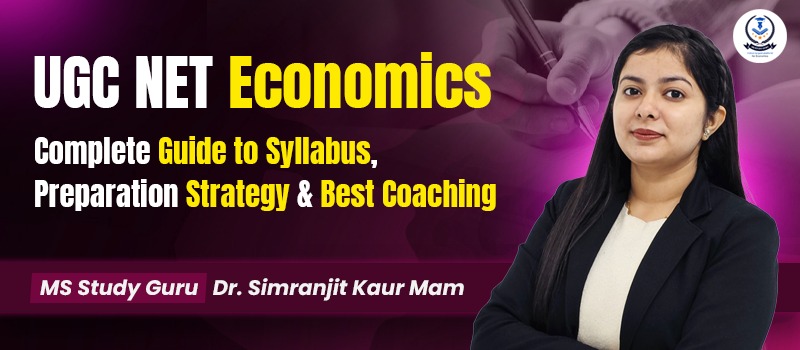
With the competition rising every year, relying on surface-level preparation or outdated study patterns will not yield results. In this comprehensive guide, we will break down the ugc net economics syllabus 2026, review the highest-yielding ugc net economics books, evaluate the role of the ugc net economics question paper, and showcase how MS Study Guru under the leadership of Dr. Simranjit Kaur Mam provides the absolute best coaching for ugc net economics.
Understanding the UGC NET Economics Exam Pattern
Before diving deep into the units, every aspirant must be thoroughly aligned with the official National Testing Agency (NTA) exam pattern. The exam is conducted in a single session as a Computer-Based Test (CBT) with no break between the two papers:
- Paper 1 (General Aptitude): Consists of 50 questions worth 100 marks. It tests teaching aptitude, research methodology, mathematical reasoning, data interpretation, and logical thinking.
Ms Study Guru - Paper 2 (Core Subject): Focuses entirely on ugc net economics. It consists of 100 questions worth 200 marks.
Physics Wallah
Detailed Breakdown of the UGC NET Economics Syllabus 2026
To clear the exam, you need a precise blueprint of the economics ugc net syllabus. The entire domain of Paper 2 is divided into 10 foundational units. A successful strategy requires a balanced approach across both theoretical frameworks and mathematical/statistical models.
1. Microeconomics
This unit covers the core principles of economic actions at individual and firm levels. Key concepts include the Theory of Consumer Behaviour, Theory of Production and Costs, Decision making under uncertainty, Game Theory , Factor Pricing, and General Equilibrium Analysis.
2. Macroeconomics & Monetary Economics
Here, the focus shifts to aggregate economic behaviors. Students must master National Income accounting, Classical & Keynesian approaches to output and employment, Consumption and Investment functions, the Multiplier and Accelerator principles, Demand and Supply of Money, and the heavily tested IS-LM Model approach. It also covers the Phillips Curve, Business Cycles, and the critique of the Rational Expectation Hypothesis.
3. Statistics and Econometrics
This is often considered a challenging unit, but it carries immense weight. It spans Probability Theory, Descriptive Statistics, Sampling Methods, Statistical Inference, Linear Regression Models (BLUE properties), the Identification Problem, and basic Time Series Analysis.
4. Mathematical Economics
Analytical questions are frequently framed from this unit. Focus heavily on Sets, functions, continuity, Differential Calculus and its applications, Linear Algebra (Matrices and Vector Spaces), Input-Output Models, and Linear Programming.
5. International Economics
Key topics include theories of International Trade (Classical, Neo-classical, and Imperfect competition models), Balance of Payments (BOP) adjustments, Exchange Rate theories, Tariffs and Non-Tariff barriers, Trade Multipliers, and global bodies like the WTO, IMF, and World Bank.
6. Public Economics
This unit reviews the government's role in the economy. Essential areas include Market Failure remedies, Public Revenue (Direct & Indirect taxation, tax incidence), Public Expenditure, Public Debt management, and Fiscal Policy implications.
7. Money and Banking
A highly scoring unit covering the Components of Money Supply, Central Bank operations, Commercial Banking functions, instruments of Monetary Policy, Non-banking Financial Institutions (NBFIs), and Capital Market regulations.
8. Growth and Development Economics
Understand the distinctions between economic growth and development. Master theories by Adam Smith, Ricardo, Marx, Schumpeter, and Rostow. Focus closely on growth models (Harrod-Domar, Solow, Robinson, Kaldor) along with development indicators like PQLI, HDI, and SDGs.
9. Environmental Economics and Demography
Covers Environment as a Public Good, the Coase Theorem, Cost-Benefit Analysis, Valuation of Environmental Goods, Population Theories, and demographic measures (fertility, mortality, life tables, and migration parameters).
10. Indian Economy
A highly dynamic unit requiring integration with real-time data. Focus on the structure of growth in India across Agriculture, Industry, and Services. Study structural changes, Land/Labour/Capital reforms, Centre-State financial relations (Finance Commissions), Poverty, Unemployment, and the FRBM Act.
The Ultimate Booklist: Best Book for UGC NET Economics
Self-study tools form the backbone of your preparation stack. To build conceptual depth, experts recommend referencing standard textbooks for distinct units rather than relies on single all-in-one guidebooks.
- Microeconomics: H.L. Ahuja or Koutsoyiannis (Advanced Economic Theory)
- Macroeconomics: H.L. Ahuja (Macroeconomics) or Froyen
- International Economics: Dominick Salvatore
- Public Finance: Lekhi or H.L. Bhatia
- Development Economics: M.L. Jhingan
- Mathematical Economics & Statistics: S.C. Gupta (Fundamentals of Statistics) and Edward T. Dowling (Schaum's Outline)
- Econometrics: Damodar Gujarati (Basic Econometrics)
- Indian Economy: Mishra & Puri, complemented by the latest Economic Survey of India and Union Budget.
UGC NET Economics
While searching for the best book for ugc net economics, remember that textbooks build foundational theory but lack the dynamic agility needed to crack complex, multi-layered NTA questions.
Why MS Study Guru is the Best Online Coaching for UGC NET Economics
While standard textbooks give you raw data, they fail to provide the exact context required to clear competitive exams. This is where strategic guidance changes the game. MS Study Guru, led by the renowned Dr. Simranjit Kaur Mam, has emerged as the definitive destination for ugc net economics online coaching.
Unlike traditional platforms that hand out generic, pre-packaged text files, MS Study Guru approaches preparation with a distinct philosophy:
1. Video Lectures for Clear Concepts (No Curated Notes Shortcuts!)
At MS Study Guru, we firmly believe that memorizing text summaries will not help you clear the analytical questions asked by the NTA. We provide high-impact video lectures for absolute concept clarity. Dr. Simranjit Kaur Mam breaks down abstract economic models, mathematical formulas, and econometrics equations step-by-step on screen, ensuring you understand the underlying mechanism rather than just memorizing definitions.
2. Notes Structured Strictly According to the Exam Pattern
The companion study notes built within the course ecosystem are not random paragraphs taken from text materials. Every set of revision notes is created and structured strictly according to the contemporary NTA exam pattern. This helps you map out exactly what kind of multiple-choice questions can be framed from a specific topic.
3. Strategic Mastery over the UGC NET Economics Question Paper
Solving the ugc net economics question paper from previous years (PYQs) is mandatory. Dr. Simranjit Kaur Mam integrates detailed PYQ explanations directly within the video modules. This enables students to understand how NTA tweaks options, how to eliminate wrong answers, and how to maintain high accuracy under strict exam time limits.
UGC NET Economics
Preparation Strategy to Crack JRF 2026
If you are aiming for the upcoming ugc net economics exam date 2026, use this strategic three-phase timeline designed by MS Study Guru:
Phase 1: Deep Concept Building (Months 1–3): Watch the targeted video lectures on MS Study Guru. Focus intensely on Core Micro, Macro, and Mathematical Economics. Avoid rushing through topics; aim for complete clarity.
Phase 2: Exam-Oriented Mapping (Month 4): Align your understanding with the exam-focused notes. Start cross-referencing your concepts with real questions from past exam papers.
Phase 3: The PYQ & Mock Drill (Month 5–Exam): Solve at least the last 10 years of question papers. Take full-length, timed mock tests to adapt to the CBT interface, build speed, and eliminate exam anxiety.
Frequently Asked Questions (FAQs)
Q1. Can I prepare for the ugc net economics syllabus 2026 without a strong mathematics background?
Yes. While the economics ugc net syllabus includes Mathematical Economics and Econometrics, you do not need an advanced engineering or math degree. MS Study Guru focuses on teaching these units right from the absolute basics through video lectures, building your skills step-by-step so you can easily solve numerical and conceptual problems.
Q2. How can I download the official syllabus?
You can easily complete your ugc net economics syllabus pdf download from the official NTA website or directly access the curated, unit-wise syllabus framework on the MS Study Guru mobile application.
Q3. Does MS Study Guru provide readymade text notes for the entire course?
No. To ensure top-tier preparation, we do not provide curated notes shortcuts. We prioritize video lectures for concept clarity so you understand the "why" behind every economic model. The supportive study materials provided are strictly structured according to the latest NTA exam pattern to guide your revision effectively.
Q4. How vital is Paper 1 in clearing the cut-off for UGC NET Economics?
Paper 1 is highly critical. Since Paper 2 can be deeply analytical and time-consuming, scoring 70+ marks in Paper 1 significantly boosts your aggregate score, making it much easier to clear the high cut-off required for the Junior Research Fellowship (JRF).
Q5. When will the next exam be conducted?
NTA generally conducts the exam twice a year (June and December cycles). For the most accurate and updated timeline regarding applications, eligibility criteria, and shifts, keep a regular check on the official NTA notifications for the ugc net economics exam date 2026.



Comments (1)
shriwan pandey
Hii ... I am preparing for upsc i gave my first attempt this year and know i am thinking to give net from economics subject for december attempt . Help me find a way in which i can sustain with my upsc preparation also.