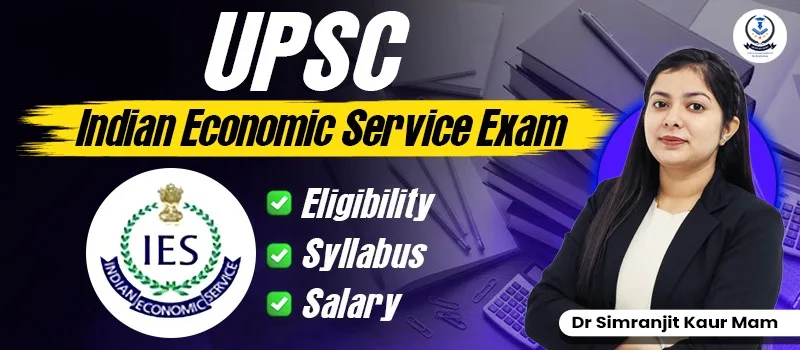

UPSC Indian Economic Service (IES) Exam: Eligibility, Syllabus, Salary & Pattern
The Indian Economic Service (IES) is an elite Group 'A' Central Civil Service under the Ministry of Finance, Government of India. Unlike the administrative civil services that prioritize general governance, the IES is designed exclusively for specialist economists. Officers in the IES shape the nation's financial architecture, formulate macroeconomic policies, advise on trade and fiscal reforms, and evaluate development projects across key ministries and bodies like NITI Aayog.Conducted annually by the Union Public Service Commission (UPSC), the Indian Economic Service exam demands advanced theoretical knowledge, mathematical rigor, and real-world policy application. This guide breaks down the eligibility criteria, detailed syllabus, exam pattern, career progression, salary structure of an IES officer, and how MS Study Guru can support your preparation.
Indian Economic Service Eligibility Criteria
Due to the specialized nature of economic policy framing, the Indian Economic Service eligibility criteria set stricter educational requirements than generalist civil services.1. Educational Qualification
Candidates must hold a Postgraduate Degree (Master's) from a recognized state/central university or an institution established by an Act of Parliament in one of the following exact streams:- Economics
- Applied Economics
- Business Economics
- Econometrics
2. Age Limit & Relaxations
Applicants must be between 21 and 30 years old as of August 1st of the exam year. Category-wise upper age relaxations are strictly enforced according to central government rules:| Category | Upper Age Limit | Total Relaxed Limit |
| Unreserved / EWS | 30 Years | 30 Years |
| OBC (Non-Creamy Layer) | +3 Years | 33 Years |
| SC / ST | +5 Years | 35 Years |
| Persons with Benchmark Disabilities (PwBD) | +10 Years | 40 Years |
| Ex-Servicemen / Defence Personnel | Up to +5 Years | 35 Years |
3. Nationality & Attempt Restrictions
- Nationality: Candidates must be a citizen of India, or a subject of Nepal/Bhutan, or a Tibetan refugee settled in India prior to January 1, 1962.
- Attempts: Unreserved/General candidates are allowed 6 attempts, OBC candidates get 9 attempts, while SC/ST candidates face no attempt limits within their permissible age window.
UPSC IES Exam Pattern & Selection Stage
The selection process for the Indian Economic Service exam involves two distinct stages totaling 1,200 marks:- Written Examination (1,000 Marks): Descriptive subjective papers conducted over 3 days.
- Personality Test / Viva-Voce (200 Marks): A formal interview by the UPSC panel to assess analytical capabilities, problem-solving skills, and economic acumen.
Written Exam Mark Distribution
| Paper No. | Subject | Duration | Maximum Marks | Type |
| Paper I | General English | 3 Hours | 100 Marks | Descriptive |
| Paper II | General Studies | 3 Hours | 100 Marks | Descriptive |
| Paper III | General Economics I | 3 Hours | 200 Marks | Descriptive |
| Paper IV | General Economics II | 3 Hours | 200 Marks | Descriptive |
| Paper V | General Economics III | 3 Hours | 200 Marks | Descriptive |
| Paper VI | Indian Economics | 3 Hours | 200 Marks | Descriptive |
| Total | Written Score | -- | 1,000 Marks | -- |
Comprehensive Indian Economic Service Syllabus
The Indian Economic Service syllabus spans graduate-to-advanced research levels across six distinct papers.Paper 1: General English (100 Marks)
Tests writing skills and command over standard English grammar:- Essay Writing (30 Marks)
- Précis Writing (30 Marks)
- Paragraph Writing (10 Marks)
- Grammar, Vocabulary, and Syntax Exercises (30 Marks)
Paper 2: General Studies (100 Marks)
Assesses general awareness of current events and basic domain knowledge across four segments (25 Marks each):- Indian History: Modern history, freedom struggle, and cultural heritage.
- Indian Polity: Constitutional principles, governance structures, and public administration.
- Indian Geography: Physical, economic, and human geography.
- General Awareness: National & international socio-economic issues.
Paper 3: General Economics I (200 Marks)
This paper heavily emphasizes analytical, mathematical, and econometric approaches.- Microeconomics (Part A): Consumer theory, production dynamics, market structures (Monopoly, Oligopoly, Game Theory), General Equilibrium models, and Welfare Economics.
- Quantitative & Econometric Methods (Part B):
- Mathematical Economics: Differential calculus, optimization techniques, input-output models, linear programming.
- Statistics & Econometrics: Probability theory, sampling techniques, classical linear regression models (OLS), heteroskedasticity, autocorrelation, multicollinearity, and time-series analysis.
Paper 4: General Economics II (200 Marks)
Focuses on macroeconomic theories, open economy models, and development paradigms.- Macroeconomics: Keynesian vs. Classical models, IS-LM framework, inflation-unemployment trade-off (Phillips Curve), monetary policy mechanisms, and business cycles.
- Development Economics: Growth theories (Harrod-Domar, Solow, Endogenous models), poverty & inequality indices, Lewis dual-sector model, structural transformation.
- International Economics: Comparative advantage, Trade policy, tariff structures, balance of payments, exchange rate dynamics, and international financial institutions (IMF, World Bank).
Paper 5: General Economics III (200 Marks)
Covers public finance, market dynamics, and structural policies.- Public Finance: Public goods, externalities, taxation mechanisms, fiscal deficit dynamics, public debt management, and fiscal federalism.
- Environmental Economics: Renewable/non-renewable resource management, valuation of non-market goods, climate change policies, carbon pricing.
- Industrial & Agricultural Economics: Market concentration, industrial pricing strategies, land reforms, agricultural pricing policy, and supply-chain linkages.
Paper 6: Indian Economics (200 Marks)
Evaluates deep knowledge of India's historical and structural economic journey.- History of Indian Economy: Pre-independence agrarian structure, post-1951 planning strategies, and 1991 structural adjustment reforms.
- Current Macro Trends: Agriculture performance, industrial growth, services sector expansion, demographic transition, labor market dynamics, and poverty alleviation strategies.
- Fiscal & Banking Architecture: Tax architecture (GST), monetary policy framework (MPC), banking sector non-performing assets (NPAs), and financial inclusion.
- External Sector & Planning: Foreign direct investment (FDI) policies, India's trade trajectory, external debt profile, and policy execution under NITI Aayog.
Indian Economic Service Salary Structure & Benefits
The Indian Economic Service salary matches the Group 'A' Gazetted Officer pay level under the 7th Central Pay Commission (CPC) framework.Entry-Level In-Hand Salary Breakdown
When recruited, a candidate starts as an Assistant Director / Junior Time Scale (JTS) Officer.- Pay Level: Level 10 (Pay Matrix: ₹56,100 to ₹1,77,500)
- Basic Pay: ₹56,100 per month
- Dearness Allowance (DA): ~₹28,000–₹33,600 (subject to prevailing DA rates)
- House Rent Allowance (HRA):
- Class X Cities (Metros): 24%–30% of Basic Pay (~₹13,464–₹16,830)
- Class Y Cities: 16%–20% of Basic Pay
- Class Z Cities: 8%–10% of Basic Pay
- Transport Allowance (TA): ₹7,200 + DA on TA
- Approximate Gross Starting Pay (Metros): ₹1,07,000 – ₹1,10,000 per month
Perks and Government Privileges
- Official Quarters: Government housing allocations in prime locations (e.g., Central Government Residential Estates in New Delhi).
- Medical Benefits: Complete coverage under the Central Government Health Scheme (CGHS) for officers and dependents.
- Travel Perks: Official transport facilities or fuel allowances, alongside Leave Travel Concessions (LTC).
- Pension & Security: Coverage under the National Pension System (NPS) along with gratuity and Group Insurance benefits.
IES Officer Hierarchy & Career Progression
Promotions in the Indian Economic Service are time-bound and performance-oriented, leading up to senior advisory roles in the Government of India.- Junior Time Scale (JTS) → Assistant Director / Junior Research Officer (Level 10)
- Senior Time Scale (STS) → Deputy Director / Senior Research Officer (Level 11 / 12)
- Junior Administrative Grade (JAG) → Joint Director / Director (Level 13)
- Senior Administrative Grade (SAG) → Senior Economic Adviser / Joint Secretary Equivalent (Level 14)
- Higher Administrative Grade (HAG / HAG+) → Principal Economic Adviser / Additional Secretary (Level 15 / 16)
- Apex Scale → Chief Economic Adviser / Secretary Level (Level 17)
Preparation Strategy for the IES Exam
- Build a Core Foundation in Quant: Paper 3 (GE-I) requires strong skills in mathematical economics and econometrics. Focus on Optimization, Linear Algebra, and Hypothesis Testing early on.
- Master Standard Academic Textbooks:
- Microeconomics: H.L. Ahuja, Hal Varian, Nicholson & Snyder.
- Macroeconomics: Dornbusch & Fischer, H.L. Ahuja.
- Public Finance: Musgrave & Musgrave, H.L. Bhatia.
- Indian Economics: Uma Kapila, Mishra & Puri, along with the latest Economic Survey and Union Budget documents.
- Answer Writing Practice: Since the exam consists entirely of descriptive papers, practice writing concise answers that incorporate economic models, diagrams, algebraic derivations, and relevant real-world data points.
How MS Study Guru Helps You Crack the IES Exam
Preparing for a six-paper descriptive exam like the IES needs structured guidance, not just self-study. Under the mentorship of Dr. Simranjit Kaur, MS Study Guru. supports aspirants at every stage of their IES journey with:- Video Lectures: Concept-wise recorded and live video lectures covering Microeconomics, Macroeconomics, Econometrics, Public Finance, and Indian Economics — so students can learn at their own pace and revisit difficult topics anytime.
- Structured Notes & Study Material: Exam-oriented, updated notes mapped directly to the UPSC IES syllabus, including diagrams, derivations, and the latest Economic Survey/Budget updates.
- Answer Writing Practice & Evaluation: Regular descriptive answer-writing assignments with personalized feedback to help students improve presentation, structure, and use of economic models.
- Test Series & Mock Papers: Paper-wise and full-length mock tests modeled on the actual IES pattern, with detailed solutions and performance analysis.
- Doubt-Clearing Sessions: Live or one-on-one doubt-resolution sessions so no concept is left unclear.
- Mentorship & Guidance: Personal mentorship on exam strategy, time management, and interview (Personality Test) preparation from experienced faculty.
- Current Affairs & Economic Survey Updates: Regular updates on macroeconomic trends, government schemes, and policy changes relevant to Paper 6 (Indian Economics).
Comments (0)