
UPSC Indian Economic Service (IES) Course & Syllabus 2026
UPSC Indian Economic Service (IES) Course & Syllabus 2026
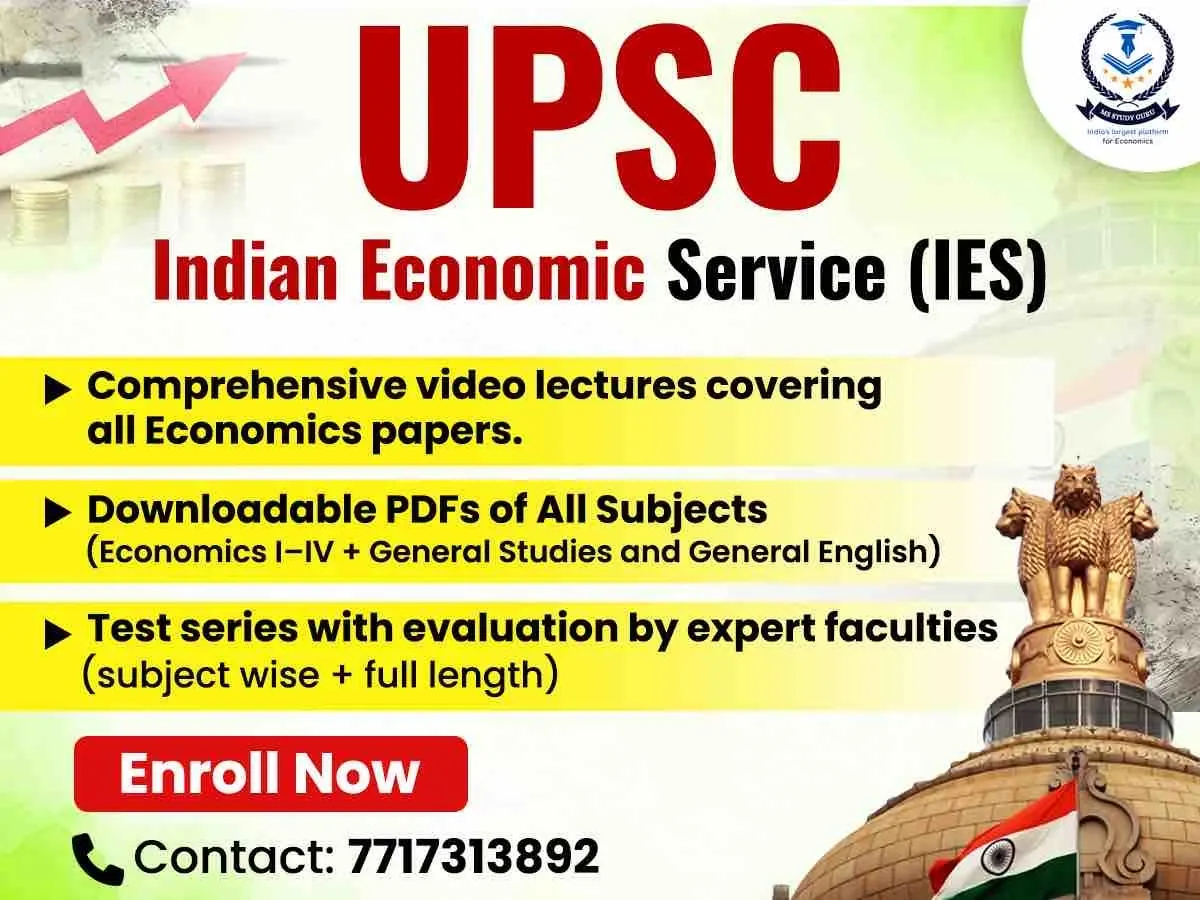
Clearing UPSC Indian Economic Service in one attempt demands more than random economics revision — it demands a plan built specifically for a 1200-mark, six-paper exam. Ms Study Guru's UPSC Indian Economic Service (IES) Course & Syllabus program, designed and delivered exclusively by Dr. Simranjit Kaur, brings video lectures, downloadable PDFs, full-length test series, and previous year questions under one structured plan. Whether you're an Economics postgraduate targeting a Group 'A' officer role or a repeat candidate refining your strategy, this course is built to take you from syllabus overwhelm to interview-ready confidence.
Why This UPSC IES Course Works
Most aspirants approach IES the way they'd approach any generalist civil services exam — and that's exactly where they lose marks. The Indian Economic Service exam tests advanced, paper-specific economics across six papers (General English, General Studies, and General Economics I–III plus Indian Economics), so generic coaching simply doesn't map to the pattern. This course is different: every unit is tied directly to the official IES Syllabus 2026, with conceptual teaching followed by analytical, exam-style practice. That paper-by-paper alignment is what separates focused UPSC IES preparation from one-size-fits-all civil services coaching.
What's Included in the IES Online Coaching
The IES Online Coaching bundles four essentials most standalone resources sell separately:
Video Lectures & Downloadable PDFs
Expert-led video lectures cover Economics I–IV and General Studies, paired with downloadable PDFs for offline revision. Every topic is explained conceptually first, then reinforced with analytical examples — so you're not just memorizing definitions, you're learning to apply them under exam conditions.
Full-Length & Sectional Test Series
A full-length IES Test Series simulates the real UPSC exam experience — sectional tests for focused practice, and full-length papers for stamina and time management. Detailed performance analysis after every test shows exactly where to improve before the actual exam.
Previous Year Questions & Analytical Practice
Previous year questions are woven into every unit, not bolted on at the end, so pattern-recognition becomes second nature well before exam day.
Indian Economic Service Exam Pattern & Syllabus 2026
The UPSC IES exam runs across three days and six papers, totaling 1000 written marks plus a 200-mark interview: General English and General Studies on Day 1, General Economics I and II on Day 2, and General Economics III plus Indian Economics on Day 3. The course's IES Syllabus 2026 coverage mirrors this exact structure, so Microeconomics, Macroeconomics, Statistics, Public Finance, and Indian Economy are all taught in the sequence and depth the actual exam demands — not as a generic economics refresher.
Meet Your Educator — Dr. Simranjit Kaur
Dr. Simranjit Kaur is a renowned economics educator with over five years of experience preparing candidates for UGC NET and UPSC Indian Economic Service. A gold medalist from SGTB Khalsa College for Women, Amritsar, and a former Assistant Professor at Khalsa College, she is also a best-selling author of Economics preparation books. Her paper-wise teaching approach is built specifically around the IES pattern, giving this course a level of exam-specific focus generic UPSC coaching centers can't replicate.
Who Should Enroll
- Economics, Applied Economics, Business Economics, or Econometrics postgraduates aged 21–30
- Final-year Master's students eligible to apply provisionally
- Working professionals who need flexible, video-based preparation
- Repeat candidates wanting a structured, paper-wise second attempt
Together, this makes it one of the most complete options for anyone comparing Indian Economic Service Course providers this cycle. Read the companion guide, Indian Economic Service (IES) 2026: Complete Guide, for a deeper walkthrough of eligibility and career growth.
How to Enroll
Enrollment takes minutes: pick your batch, get instant access to video lectures, downloadable PDFs, and the test series, and start following the paper-wise study plan from day one. Seats for the 2026 cycle are limited.
Know More About This Course : Click Here
Enroll Now
FAQ
Q1: How to become an IES officer in economics?
Ans. To become an IES officer, you must clear the UPSC Indian Economic Service exam — a written test of 1000 marks across six papers followed by a 200-mark interview. Structured guidance covering Microeconomics, Macroeconomics, and Indian Economy is key to cracking it on your first attempt.
Q2: What is the eligibility for Indian Economic Service?
Ans. Candidates need a Post-Graduate degree in Economics, Applied Economics, Business Economics, or Econometrics, and must be between 21 to 30 years old (with category-wise relaxations). Final-year Master's students can also apply for the UPSC Indian Economic Service exam provisionally.
Q3: Is Indian Economic Service equal to IAS?
Ans. No, IES and IAS are different services — IAS is a generalist administrative service, while UPSC Indian Economic Service is a specialized Group 'A' service focused purely on economic policy, planning, and research. IES officers work as key economic advisors across government ministries.
Q4: What is the salary of an IES economics officer?
Ans. An IES officer starts as a Group 'A' Gazetted Officer with a starting basic pay of around ₹56,100 per month (Level 10, 7th CPC), plus allowances like DA, HRA, and TA. Salary and rank grow steadily through the UPSC Indian Economic Service career hierarchy.
Q5: How many seats are in Indian Economic Service?
Ans. The number of IES seats varies each year based on government vacancies, typically ranging between 20-40 posts. Since competition is high and seats are limited, focused UPSC Indian Economic Service preparation with the right study material and test series is essential to secure a rank.