
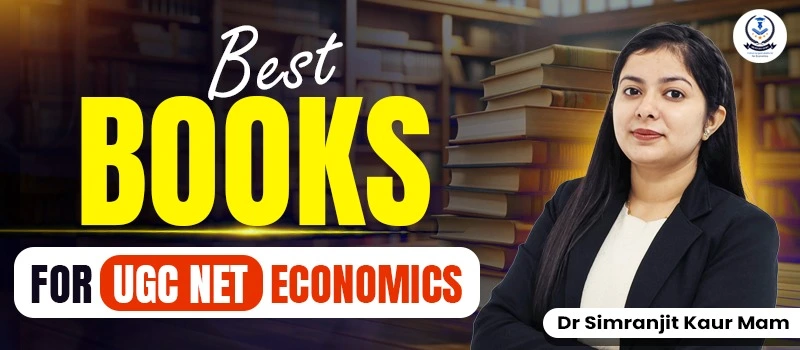

Picking the best books for UGC NET Economics is the first step toward a good score. Good books do not just help you cram facts. They help you actually understand the topics so you can solve assertion-reasoning questions and data-based questions with confidence.
In this guide, we share a unit-wise list of UGC NET Economics books, explain why the right books matter, and show you how to prepare smartly for the Junior Research Fellowship (JRF).
Why UGC NET Economics Books Matter
Many students jump straight into solving previous year papers without first building their basics. Papers are useful for practice, but they cannot replace good textbooks. Here's why:- Real understanding: The NTA keeps making the exam harder. Questions are rarely simple. Good books help you understand the reason behind theories, formulas, and graphs, not just memorize them.
- Correct facts and definitions: Standard books give you accurate definitions, formulas, and history, so you don't end up learning something wrong.
- Full unit coverage: Since the syllabus is so wide, the right books make sure you don't miss important topics in units like Econometrics, Public Finance, and International Trade.
Unit-Wise Books for UGC NET Economics
The syllabus has 10 units. Here is a simple, unit-wise list of books to help you build your study plan.Unit 1: Microeconomics
This unit is the base of the whole exam. NTA often asks about consumer behavior, cost of production, market types, and welfare economics.Books to read:
- Advanced Economic Theory by H.L. Ahuja
- Microeconomic Analysis by Hal Varian
Unit 2: Macroeconomics
This unit needs a good grip on national income, schools of thought, and government policy.Books to read:
- Macroeconomics: Theories and Policies by Richard T. Froyen
- Macroeconomic Theory and Policy by H.L. Ahuja
Unit 3: Development Economics and Growth Models
This unit can fetch easy marks if you learn the assumptions of each growth model well.Books to read:
- Economics of Development and Planning by M.L. Jhingan
- Economic Development by Michael P. Todaro and Stephen C. Smith
Unit 4: Mathematical Economics
This unit scares many students, but basic calculus and matrix algebra can give you an edge.Book to read:
- Fundamental Methods of Mathematical Economics by Alpha C. Chiang and Kevin Wainwright
Unit 5: Statistics and Econometrics
Questions here have become more analytical. Focus on the basic rules of linear regression and what happens when those rules break.Books to read:
- Basic Econometrics by Damodar N. Gujarati
- Fundamentals of Mathematical Statistics by S.C. Gupta and V.K. Kapoor
Unit 6: International Economics
Trade theories and balance of payments (BoP) are asked often in both papers.Books to read:
- International Economics by Dominick Salvatore
- International Economics by H.G. Mannur
Unit 7: Public Economics (Public Finance)
This unit connects theory with real government policy.Books to read:
- Public Finance in Theory and Practice by Richard A. Musgrave and Peggy B. Musgrave
- Public Finance by H.L. Bhatia
Unit 8: Money and Banking
A simple, direct unit. Just keep track of changes in the financial system.Books to read:
- Money, Banking, International Trade and Public Finance by M.L. Jhingan
- RBI official reports and bulletins
Unit 9: Environmental Economics and Demography
This unit is getting more important, especially on environmental treaties and population data.Books to read:
- Environmental Economics by Charles D. Kolstad
- Principles of Demography by Donald J. Bogue
Unit 10: Indian Economy
This section keeps changing. Use textbooks only for history and structure, and check the latest reports for current data.Books to read:
- Indian Economy by Ramesh Singh (or Mishra and Puri)
- Latest Economic Survey of India and Union Budget
Latest UGC NET Exam Updates
Keeping up with exam changes is very important. The NTA is now testing real understanding, not just memory.- More applied questions: Recent papers show more assertion-reasoning and case-study questions, mainly in Econometrics and Microeconomics.
- Current data matters: For Indian Economy, direct questions from the latest Economic Survey, Union Budget, and RBI repo rates are common now. Always pair your books with the latest official reports.
Quick Book Reference Table
| Unit | Unit Title | Recommended Book | Author |
| 1 | Microeconomics | Advanced Economic Theory | H.L. Ahuja |
| 2 | Macroeconomics | Macroeconomics: Theories & Policies | Richard T. Froyen |
| 3 | Development Economics | Economics of Development & Planning | M.L. Jhingan |
| 4 | Mathematical Economics | Fundamental Methods of Mathematical Economics | Alpha C. Chiang |
| 5 | Statistics & Econometrics | Basic Econometrics | Damodar N. Gujarati |
| 6 | International Economics | International Economics | Dominick Salvatore |
| 7 | Public Economics | Public Finance | H.L. Bhatia |
| 8 | Money and Banking | Money, Banking, International Trade & Public Finance | M.L. Jhingan |
| 9 | Environmental & Demography | Environmental Economics | Charles D. Kolstad |
| 10 | Indian Economy | Indian Economy & Economic Survey | Ramesh Singh / Govt of India |
Final Word and Next Step
Building a strong book list is the first step toward your goal of becoming an assistant professor or clearing JRF. But reading through thousands of pages and getting stuck in tough math proofs (that may not even show up in the exam) can feel very tiring.At MS Study Guru, led by Dr. Simranjit Kaur, one of India's best mentors for UGC NET JRF, we help you cover the gap between heavy books and smart study. Instead of giving you plain notes that are hard to follow, we offer clear video lectures that break down tricky models, formulas, and data in a simple way, with a strong focus on building real conceptual clarity.
Ready to change how you prepare? Visit MS Study Guru today for structured video courses, mock tests, and expert strategy sessions to help you score well in the coming exam.
UGC NET Economics Books FAQs
Which is the single best book for UGC NET Economics?No one book covers all ten units. Since the syllabus is so wide, from Microeconomics to Econometrics to Indian Economy, you need different books for different units, like H.L. Ahuja for theory and Damodar Gujarati for econometrics.
How should I study the Indian Economy unit for UGC NET?
Use books like Ramesh Singh for background and structure. But you must also read the latest Union Budget, Economic Survey of India, and recent updates from RBI and NITI Aayog, since this unit changes every year.
Can I clear UGC NET Economics without coaching if I read all these books?
Yes, self-study can work if you master these books and practice past papers regularly. But tricky units like Econometrics and Mathematical Economics can be hard to understand alone. Structured video lectures from Dr. Simranjit Kaur can save you time and give you the conceptual clarity you need to score well.


Comments (2)
Azi
Hi...I want to know if there is a book with detailed notes for all units
Azi
Hi...I want to know if there is a book with detailed notes for all units