
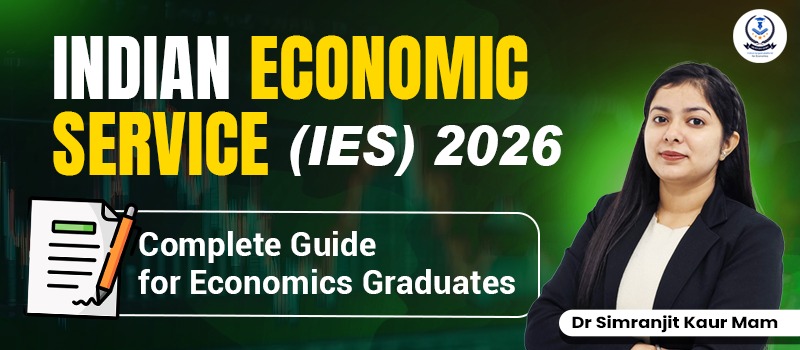
Indian Economic Service (IES) is not a general aptitude exam. It is a specialist economics exam where your depth of understanding and the quality of your written answers decide your selection. The papers check how clearly you understand economic theory and how well you can apply it to real issues in the Indian economy.
This blog will guide you on how to prepare smartly for IES and how a structured online coaching course can support your journey. The focus is on building clear concepts, following a disciplined study plan, and practising answer writing so that you think and write like a professional economist in the exam hall.
Indian Economic Service (IES) is a Group “A” central government service for trained economists. As an IES officer, you work in different ministries and departments of the Government of India, where you handle policy analysis, data-based decision-making, and evaluation of major government schemes and programmes.
The UPSC IES exam has six descriptive papers:
- General English
- General Studies
- Four economics papers (three General Economics papers and one Indian Economics paper)
The IES exam demands written, analytical answers, not guesswork. You are expected to:
- Explain economic models and their assumptions in your own words
- Show logical steps and basic derivations where needed
- Draw and label diagrams clearly
- Connect theory with Indian data, reports, and current policy debates
- Strong basics in microeconomics, macroeconomics, and Indian economy
- Comfort with statistics and econometrics ideas used in policy and research
- Practice in writing structured answers within a fixed time, with proper introductions, diagrams, and conclusions
A serious IES aspirant should look for a course that is both syllabus-focused and concept-oriented. A strong IES course should offer:
- Full syllabus coverage
All major areas like Microeconomics, Macroeconomics, General Economics, Indian Economy, and quantitative topics should be covered in a systematic, exam-aligned way. - Topic-wise video lectures
Lectures should move from basics to advanced level in a clear order so that you do not feel lost or confused in the middle of a topic. Each concept should be explained slowly and logically. - Written study material
Study material should match the needs of IES preparation and help you revise quickly before the exam. It should highlight key definitions, diagrams, and important results. - Descriptive test series
Since IES is descriptive, the course must include tests where you write full answers, get feedback, and learn how to improve your structure, depth, and diagrams.
- MA / MSc Economics students who want to target IES seriously
- Fresh economics postgraduates planning a focused IES attempt
- Working professionals who need a clear, guided study plan along with their job
You can organise your IES preparation in four simple phases.
1. Build Your Core (First 3–4 Months)
- Start with Microeconomics, Macroeconomics, and Indian Economy.
- Go through lectures or material slowly and make short notes on definitions, diagrams, formulas, and key models.
- Revise each topic at least twice so that your base becomes strong and stable.
- Move in a structured way through all General Economics papers and the Indian Economics paper.
- After each unit, solve practice questions and try to frame answers in UPSC style (introduction – main body – diagram or data – conclusion).
- Start linking theory with current economic issues, official reports, surveys, and real data.
- Attempt full-length and sectional tests in exam-like conditions.
- Time yourself and practise completing answers within the given word and time limits.
- After each test, mark your weak areas and revise those topics again from your notes and lectures.
- Closer to the exam and result time, read more on current Indian economy, key government schemes, budgets, economic surveys, and global trends affecting India.
- Use your conceptual base to form balanced and logical viewpoints that help in both written papers and the interview.
For an exam like Indian Economic Service, you need three things: clear concepts, consistent practice, and calm guidance. MS Study Guru focuses on serious economics preparation and is designed for students who want to build a strong base in economics and crack IES with a structured study plan.
At MS Study Guru, the content and approach are shaped by Dr. Simranjit Kaur. We offers one of the best combinations of expert faculty, quality study resources, structured guidance, and concept-based learning. We focuses on making complex topics easy to understand through simple explanations, diagrams, real-life examples, and step-by-step teaching methods, helping students build real understanding instead of just memorising concepts. Together, the faculty support, study material, and mentorship create a clear and effective path for serious IES aspirants.
Which phase of this IES plan do you feel you need the most help with right now: building core concepts, full syllabus coverage, or answer-writing practice?


Comments (0)