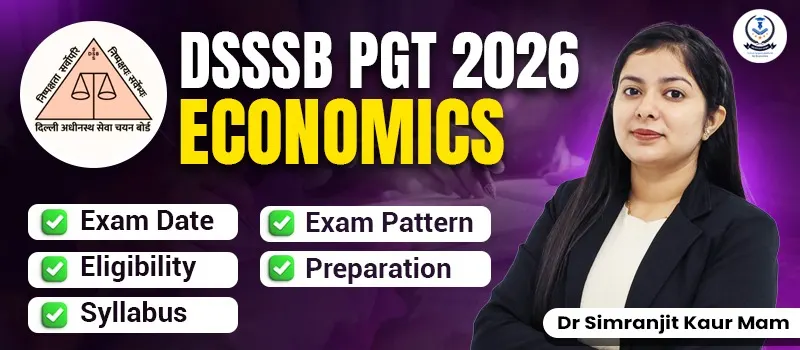

Introduction to DSSSB PGT Economics 2026
DSSSB PGT Economics is a recruitment exam conducted by the Delhi Subordinate Services Selection Board to appoint Post Graduate Teachers in Economics in Delhi government schools. The examination is meant for candidates with advanced knowledge of Economics and sound teaching aptitude who wish to teach at senior secondary level.
For serious aspirants, it is important to understand the 2026 exam date, eligibility conditions, exam pattern, detailed syllabus, and a realistic preparation strategy. At the same time, guidance from a focused Economics platform like MS Study Guru, led by Dr. Simranjit Kaur, can make the journey more structured and result‑oriented.

DSSSB PGT Economics 2026 Exam Date
The exam calendar for DSSSB 2026 has been released and provides post‑wise schedules for PRT, TGT, and PGT posts. According to the detailed schedule and subsequent exam‑wise updates:
-
DSSSB has kept separate windows for PGT exams within the broader teacher recruitment calendar for 2026.
-
For PGT Economics specifically, test‑prep portals based on the official schedule show the exam date as 15 July 2026, in the morning shift from 09:00 am to 12:00 pm, under post codes such as 10/24 and 829/24.
DSSSB sometimes revises exam dates, as seen in the shift of PGT exams in 2026 from March to July in some notices, so candidates should always re‑check the latest exam calendar and admit card for final confirmation. The safest practice is to rely on the official website (dsssb.delhi.gov.in) along with reliable teacher‑exam portals when planning travel and revision timelines.
Eligibility Criteria for DSSSB PGT Economics 2026
Understanding eligibility is crucial before planning long‑term preparation. The main conditions include educational qualification, age limit, and other basic requirements.
Educational Qualification
For PGT posts, DSSSB expects a high level of subject knowledge and professional teacher training. In general:
-
Candidates must have a Master’s degree in the concerned subject, here MA/MSc in Economics or an equivalent post‑graduate degree from a recognised university.
-
In addition, they must hold a degree or diploma in training/education such as B.Ed, as per the teacher‑education conditions laid down by DSSSB and the recruiting department.
Recent discussions and explanatory videos on eligibility also point out alternate pathways, such as candidates with a PhD in the concerned subject and strong academic record, with a condition to complete B.Ed within a certain period after joining, but the final rule remains what is written in the current year’s official notification. Thus, applicants should always read the latest advertisement for DSSSB PGT Economics before applying.
Age Limit and Relaxations
DSSSB sets age limits by post, and for PGT posts the upper limit generally lies around the mid‑thirties.
-
For PGT (Post Graduate Teacher), many 2025–26 guides report a maximum age of about 36 years, with a minimum age of around 21 years.
-
Age relaxations follow Delhi government norms, for example:
-
SC/ST: relaxation of 5 years
-
OBC: relaxation of 3 years
-
PwD: relaxation of 10 years (with higher limits when combined with reserved categories)
DSSSB does not prescribe a separate attempt limit. Candidates may apply as long as they satisfy the age limit and eligibility conditions mentioned in the notification.
DSSSB PGT Economics 2026 Exam Pattern
The DSSSB PGT exam is a computer‑based test designed to judge both general aptitude and subject‑specific knowledge.
Key features of the 2026 pattern are as follows:
-
The exam consists of 300 multiple‑choice questions, each carrying one mark, for a total of 300 marks.
-
It is divided into two main sections:
-
Section I (General Section) – Reasoning, numerical ability, general awareness, English and Hindi language, and teaching aptitude, with a total of 100 marks.
-
Section II (Subject‑Specific Section) – Core Economics content along with teaching methodology, carrying 200 marks.
-
As per 2026 pattern descriptions, there is negative marking of 0.25 mark for each wrong answer, which makes accuracy as important as speed.
-
The exam is fully objective‑type; there is no descriptive paper in the present format.
Because Section II carries twice the weight of Section I, serious Economics understanding and structured revision of the subject are the main drivers of selection.
DSSSB PGT Economics 2026 Syllabus
The syllabus for DSSSB PGT Economics is designed to test a wide range of undergraduate and post‑graduate level concepts. It can be grouped into General Aptitude (Section I) and Economics subject content (Section II).
Section I – General Aptitude and Teaching‑Related Areas
According to the 2026 PGT syllabus and pattern outlines, Section I includes:
-
General Awareness: Indian history, polity, constitution, geography, economy, culture, sports, scientific facts, and basic current affairs, with a focus on India and sometimes Delhi.
-
General Intelligence and Reasoning: Verbal and non‑verbal reasoning, series, analogies, coding‑decoding, classification, puzzles, and similar items.
-
Arithmetical and Numerical Ability: Percentages, ratios, averages, simple and compound interest, profit and loss, time and work, time and distance, and basic data interpretation.
-
English Language and Comprehension: Vocabulary, grammar, comprehension, error spotting, and sentence improvement.
-
Hindi Language and Comprehension: व्याकरण, शब्दावली, मुहावरे, गद्यांश और भाषा की बुनियादी समझ.
-
Teaching Aptitude and Methodology: Basic questions on learner needs, classroom management, evaluation methods, and role of a teacher.
Section II – Economics (Core Subject)
For PGT Economics, Section II is built mainly around four pillars, as highlighted in specialist syllabus pages and Hindi and English guides:
-
Microeconomics
-
Central problems of an economy, production possibility curve and opportunity cost.
-
Consumer’s equilibrium through utility and indifference curve approach.
-
Demand, determinants of demand, law of demand, movement along and shift of demand curve, price elasticity and methods of measurement.
-
Production function, factors of production, returns to factor and returns to scale.
-
Cost and revenue concepts, types of costs and revenues, isoquants, and producer equilibrium.
-
Supply, determinants of supply, elasticity of supply, supply curve and its shifts.
-
Forms of market (perfect competition, monopoly, monopolistic competition, oligopoly) and price determination under different market structures.
-
Basic ideas of distribution and welfare economics.
-
Macroeconomics
-
National income concepts and measurement.
-
Aggregate demand and aggregate supply, determination of income and employment.
-
Money and banking, inflation, business cycles, and stabilization policies. Government budget and fiscal policy, with stress on Indian context.
-
Statistics and Quantitative Tools
-
Measures of central tendency (mean, median, mode) and dispersion.
-
Correlation and index numbers, often at the level used in school boards.
-
Indian Economic Development
-
Structure of the Indian economy, agriculture, industry, services.
-
Planning, liberalisation, poverty, unemployment, and inequality.
-
Recent policy changes, reforms, and current economic issues in India.
In depth, PGT Economics may also include parts of development economics, public finance, international economics, and contemporary policy issues, which are often blended into questions on Indian Economy and macro topics. Candidates should always download and read the latest subject‑specific PDF for Economics when DSSSB publishes it.
How to Prepare for DSSSB PGT Economics 2026
A structured and realistic study plan is essential for this exam, especially because most aspirants are also handling other exams or work.
1. Start from the Official Pattern and Syllabus
Begin by reading the latest DSSSB PGT notification and syllabus for Economics and make a topic‑wise list for Section I and Section II. This ensures that your reading, note‑making, and test practice remain aligned with what the board actually asks.
2. Build Strong Conceptual Base in Economics
Given that Section II carries 200 marks, at least half of your study time should go to Microeconomics, Macroeconomics, Statistics, and Indian Economy. You should:
-
Revise standard undergraduate texts in a focused way.
-
Use charts and diagrams to remember models and relationships.
-
Connect theory with current events, especially for Indian Economy and policy questions.
Conceptual clarity in core ideas like demand–supply, cost curves, IS‑LM, inflation, and growth theories makes it easier to answer tricky MCQs.
3. Integrate Previous Year Questions into Daily Study
Previous year papers and good quality practice questions show the depth and style of DSSSB questions. Working with them helps you:
-
Identify high‑weight topics (for example, consumer theory, cost and revenue, national income, and Indian economy).
-
Understand how numerical and theoretical questions are balanced.
-
Learn common traps and patterns used in options.
4. Do Regular Practice for Section I
While Economics is the core, you cannot ignore Section I, which still has 100 marks. Try to give 45–60 minutes each day to:
-
Reasoning and data interpretation sets.
-
Short arithmetic drills on key chapters.
-
Mixed English and Hindi language questions.
This habit builds speed and boosts your total marks without very heavy extra effort.
5. Use Mock Tests and Timed Practice
In the last two to three months before the exam, start taking full‑length mock tests that follow the DSSSB PGT pattern with 300 questions and negative marking. After each test:
-
Analyse your performance section‑wise and topic‑wise.
-
Note questions lost due to silly errors or poor time management.
-
Adjust your strategy, for example, attempting strong topics first to secure marks early.
How Dr. Simranjit Kaur and MS Study Guru Help DSSSB PGT Economics Aspirants
For many candidates, self‑study alone is not enough, especially when they are working or preparing for multiple exams. This is where a specialised Economics platform like MS Study Guru becomes highly useful.
India’s Leading Economics‑Focused Platform
MS Study Guru is an online platform dedicated mainly to Economics exams such as UGC NET, SET, PGT, Assistant Professor, GATE, IES and similar tests. It is led by Dr. Simranjit Kaur, who has been a pioneer in Economics education and has helped countless aspirants secure NET, JRF and teaching posts.
Dr. Simranjit Kaur is India’s best tutor in UGC NET JRF with a strong focus on conceptual clarity, which directly benefits PGT Economics aspirants as well. She has:
-
Cleared JRF in Economics with 99.93 percentile, showing deep subject command.
-
Completed a PhD in Economics, with a strong research orientation
-
Authored best‑selling books for UGC NET Economics and Paper 1, widely used by students across India.
Course Support for PGT Economics
MS Study Guru offers PGT‑oriented Economics guidance through its PGT Economics preparation resources, videos, and structured Economics courses, even though the main flagship courses are for UGC NET, SET, Assistant Professor and IES. Their PGT‑focused content usually includes:
-
Complete syllabus coverage of Microeconomics, Macroeconomics, Statistics, and Indian Economy with detailed explanations.
-
Recorded and live lectures, which allow students to revise at their own pace while still following a guided sequence.
-
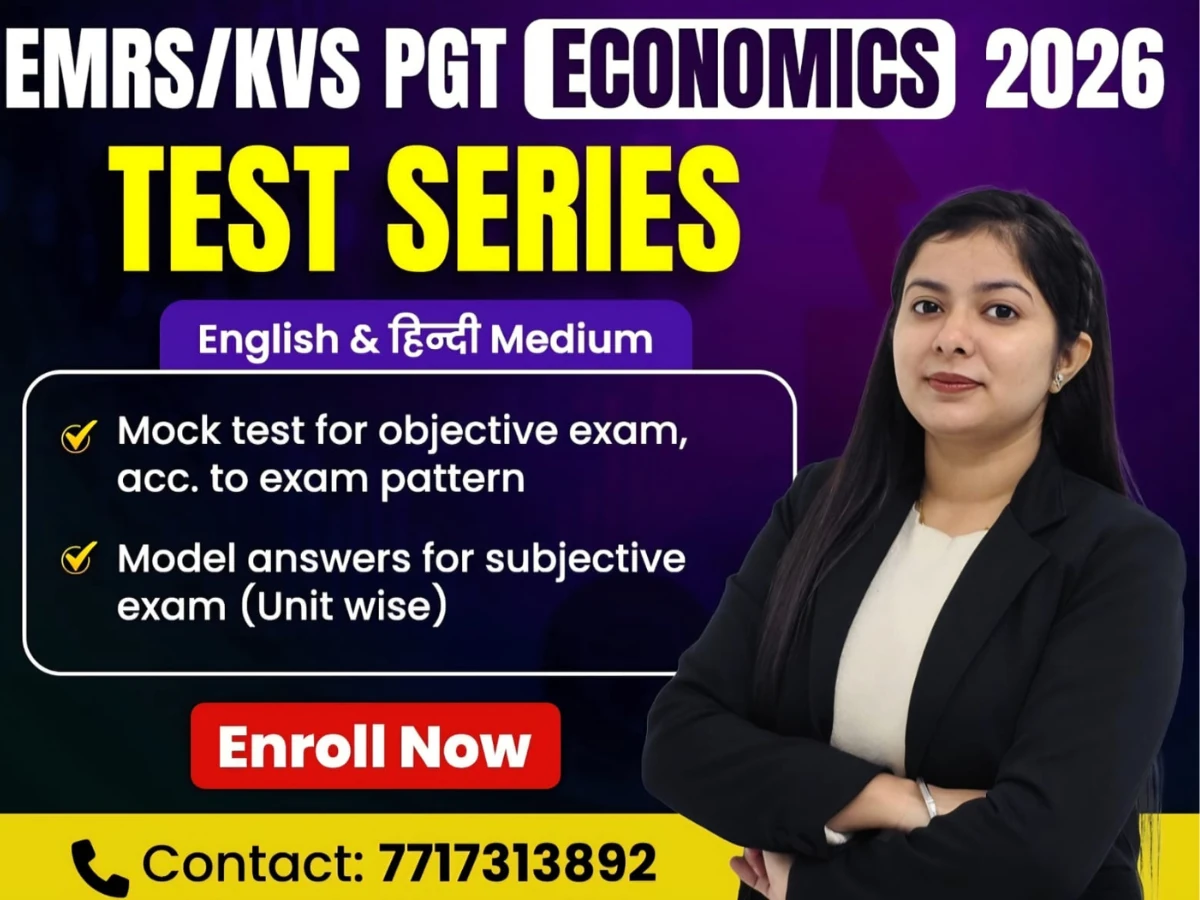
Unit‑wise tests, PYQ discussions, and full‑length mock tests, which are central to exam‑oriented preparation.
-
Model answers and explanation videos, especially useful for students who also prepare for descriptive exams like IES or Assistant Professor, and want strong written expression in Economics.
Because the content is designed around conceptual clarity and exam strategy, PGT Economics aspirants can adapt UGC NET‑level Economics lectures to cover the full DSSSB syllabus with more depth than usual coaching.
Guidance, Motivation, and Doubt Support
MS Study Guru also provides:
-
A dedicated mobile app with live classes, weekly tests, and unlimited doubt resolution.
-
Regular YouTube sessions for PGT Economics, NET, and Assistant Professor preparation, including important questions and strategy videos.
-
Continuous motivation and mentorship by Dr. Simranjit Kaur, which students often mention as a key factor in their success stories.
For a candidate targeting DSSSB PGT Economics 2026, joining a structured Economics programme with India’s best tutor in UGC NET JRF and a clear focus on conceptual clarity can significantly reduce confusion and save time.
FAQs on DSSSB PGT Economics 2026
1. What is the exam date for DSSSB PGT Economics 2026?
According to the updated schedule shared by teacher‑exam portals based on DSSSB notices, the PGT Economics exam is expected on 15 July 2026, in the morning shift (09:00 am to 12:00 pm). Candidates should confirm the final date and shift from their admit card and the official website.
2. What is the eligibility for DSSSB PGT Economics?
You need a Master’s degree in Economics or a related discipline from a recognised university, along with a degree/diploma in education such as B.Ed or its equivalent. The usual age band for PGT posts is up to about 36 years, with relaxations for SC, ST, OBC, and PwD categories as per Delhi government rules.
3. What is the exam pattern of DSSSB PGT Economics 2026?
The exam is a 300‑mark computer‑based test with 300 multiple‑choice questions. Section I (General section) carries 100 marks and covers reasoning, numerical ability, general awareness, and languages, while Section II (subject and teaching methodology) carries 200 marks with questions from Economics and pedagogy. There is negative marking of 0.25 mark per wrong answer.
4. What are the main topics in the DSSSB PGT Economics syllabus?
The core syllabus includes Microeconomics, Macroeconomics, Statistics, and Indian Economic Development, with topics such as consumer and producer theory, market structures, national income, money and banking, inflation, Indian economic structure, and basic quantitative tools. Many question sets also reflect elements of development economics, public finance, and international economics.
5. How can MS Study Guru and Dr. Simranjit Kaur help in this exam?
MS Study Guru specialises in Economics exams and offers comprehensive courses for UGC NET Economics, SET, Assistant Professor and related exams, which cover the entire Economics syllabus with strong conceptual focus. Under the leadership of Dr. Simranjit Kaur, India’s best tutor in UGC NET JRF with a strong focus on conceptual clarity, the platform provides recorded and live classes, notes, PYQ solutions, tests and continuous mentorship that PGT Economics aspirants can use to prepare in a systematic and efficient way for DSSSB 2026.
Comments (0)