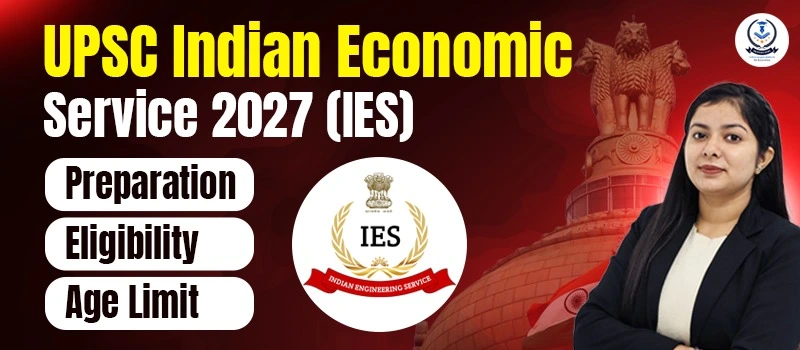

The Indian Economic Service is a premier civil service under the Government of India. Officers recruited through this exam work in key economic ministries and departments, advising the government on matters like fiscal policy, planning, trade, and economic data. It is conducted annually by the Union Public Service Commission (UPSC).
The exam is highly competitive. In the 2026 cycle, only 16 vacancies were notified for IES — which shows how selective and prestigious this service is. If you clear this exam, you enter a career where your work directly influences national economic decisions.
Before you start preparing, confirm that you meet the basic eligibility conditions. UPSC checks these conditions at the time of the interview, so it is important to be sure from day one.
Nationality
You must be a citizen of India. Subjects of Nepal, subjects of Bhutan, Tibetan refugees who came to India before January 1, 1962, and persons of Indian origin who migrated from specific countries like Pakistan, Sri Lanka, Burma, or East African countries are also eligible — provided they hold a certificate of eligibility from the Government of India.
This is one of the most important eligibility conditions, so read it carefully.
- Minimum Age: 21 years
- Maximum Age: 30 years
- Age is calculated as on 1st August of the exam year — so for IES 2027, the cut-off date will likely be 1st August 2027
Age Relaxation Table
| Category | Relaxation in Upper Age Limit |
| SC / ST | 5 years |
| OBC (Non-Creamy Layer) | 3 years |
| Defence Personnel (disabled in operations) | 3 years |
| Ex-Servicemen (5+ years of military service) | 5 years |
| ECOs/SSCOs (assignment extended beyond 5 years) | 5 years |
| Persons with Benchmark Disabilities (PwBD) | 10 years |
Important Note: SC/ST and OBC candidates who also qualify as PwBD or Ex-Servicemen can get cumulative age relaxation under both categories.
This is where the IES differs from most other UPSC exams. You don't need just a graduation degree here.
For Indian Economic Service, you must hold a Post-Graduate Degree in any of the following:
- Economics
- Applied Economics
- Business Economics
- Econometrics
Good news for final-year students: If you have appeared in your final qualifying exam but the result has not been declared yet, you can still apply. However, you will need to submit proof of passing before the interview stage.
This is where conceptual clarity in Economics becomes non-negotiable. At MS Study Guru, Dr. Simranjit Kaur focuses specifically on building strong conceptual foundations in Economics — covering everything from microeconomics and macroeconomics to Indian economy and econometrics — which are all key areas tested in IES.
You don't get unlimited attempts for this exam. UPSC sets a clear limit:
- General (UR) category: Maximum 6 attempts
- OBC category: Maximum 9 attempts
- SC/ST: No restriction on attempts (up to the age limit)[
The IES exam has two stages:
Stage 1 — Written Examination
| Paper | Marks |
| General English | 100 |
| General Knowledge | 100 |
| Economics Paper I | 200 |
| Economics Paper II | 200 |
| Economics Paper III | 200 |
| Indian Economy | 200 |
| Total Written | 1000 |
Stage 2 — Viva-Voce (Personality Test): 200 marks
Grand Total: 1200 marks
The written exam is of the conventional (descriptive) type. This means you need to write detailed, well-structured answers — not just tick the right option. That is exactly why conceptual clarity matters so much. Knowing the definition is not enough; you must be able to explain, apply, and analyse.
The application fee for IES is very affordable:
- General/OBC/EWS candidates: ₹200
- Female candidates: Nil (exempted)
- SC/ST candidates: Nil (exempted)
- Persons with Benchmark Disability (PwBD): Nil (exempted)
UPSC has not released the official notification for IES 2027 yet. However, based on the pattern followed in recent years, here is what you can expect:
| Event | Expected Timeline (2027) |
| Official Notification Release | February 2027 |
| Online Application Window | February – March 2027 |
| Admit Card Release | June 2027 |
| Written Exam (Prelims) | June 2027 (likely 3 days) |
| Interview/Viva-Voce | Late 2027 / Early 2028 |
| Final Result | 2028 |
For reference, the IES 2026 notification was released on 11th February 2026, the application window closed on 3rd March 2026, and the written exam was held from 19th to 21st June 2026. The 2027 cycle is expected to follow the same timeline.
If you are planning to appear in IES 2027, this is the right time to start. The exam covers a wide range of Economics topics at a deep conceptual level. Here is how to approach your preparation:
- Master the basics first — Microeconomics, Macroeconomics, Statistics, and Econometrics form the core of the exam.
- Work on Indian Economy separately — This paper requires up-to-date knowledge of India's economic policies, schemes, and data.
- Practice answer writing — Since the exam is descriptive, you need to write structured, crisp, and theory-backed answers regularly.
- Stay updated with current economic affairs — Budget, RBI policies, Economic Survey, and global economic trends must be part of your daily reading.
- Join a structured course — Guidance from experts like Dr. Simranjit Kaur at MS Study Guru can make a huge difference in how quickly you build conceptual clarity and exam-ready skills.
Many students make the mistake of rote-learning for IES. That strategy fails here. The exam papers demand that you apply economic theory to real-world scenarios, interpret data, and present arguments coherently.
At MS Study Guru, Dr. Simranjit Kaur — one of India's best tutors for UGC NET JRF Economics — takes the same approach for IES preparation: deep conceptual clarity over surface-level coverage. Her teaching style ensures that you not only understand the "what" but also the "why" and "how" behind every economic concept. That is the foundation on which top IES ranks are built.
Q1. What is the age limit for UPSC IES 2027?
The age limit is between 21 and 30 years, calculated as on 1st August 2027. Reserved category candidates get relaxation as per UPSC rules — SC/ST get 5 years, OBC gets 3 years, and PwBD candidates get up to 10 years.
Q2. What is the educational qualification for IES 2027?
You must hold a Post-Graduate (Master's) Degree in Economics, Applied Economics, Business Economics, or Econometrics from a recognised university in India or an approved foreign university. A Bachelor's degree alone is not enough.
Q3. Can a final-year PG student apply for IES 2027?
Yes. If your result has not been declared at the time of applying, you can still fill the application form. However, you will be required to submit proof of passing before the interview stage.
Q4. How many times can I attempt the IES exam?
General (Unreserved) category candidates can attempt the exam a maximum of 6 times. OBC candidates get up to 9 attempts. SC/ST candidates can attempt till the upper age limit.
Q5. What is the exam pattern for IES?
IES has a written exam (1000 marks total across 6 papers) followed by a Viva-Voce (200 marks). All written papers are descriptive (conventional type). The total is 1200 marks.
Q6. When is the expected IES 2027 notification date?
Based on past trends, the notification is expected in February 2027. The written exam is likely to be held in June 2027. Keep checking the UPSC official website (upsc.gov.in) for confirmed dates.
Q7. What is the application fee for IES 2027?
The fee is ₹200 for General/OBC/EWS candidates. Female candidates, SC, ST, and PwBD candidates are fully exempted from paying the fee.
Q8. Is UPSC IES only for Economics graduates?
Yes. Only candidates with a Post-Graduate degree in Economics or a closely related field (Applied Economics, Business Economics, Econometrics) are eligible. Other streams cannot apply.
Q9. Where can I prepare for IES with conceptual clarity?
MS Study Guru, led by Dr. Simranjit Kaur, offers expert Economics coaching designed to build deep conceptual understanding — which is exactly what IES demands. Visit msstudyguru.in to explore available courses.[msstudyguru]
Q10. How is IES different from other UPSC exams?
Unlike UPSC CSE, IES is a specialist exam for Economics graduates only. It focuses entirely on economics and does not include General Studies papers. It is also fully descriptive, requiring strong subject knowledge and answer-writing skills.
Comments (0)