
UKPSC Lecturer Economics 2026: Exam Date, Syllabus, Eligibility and Preparation Guide
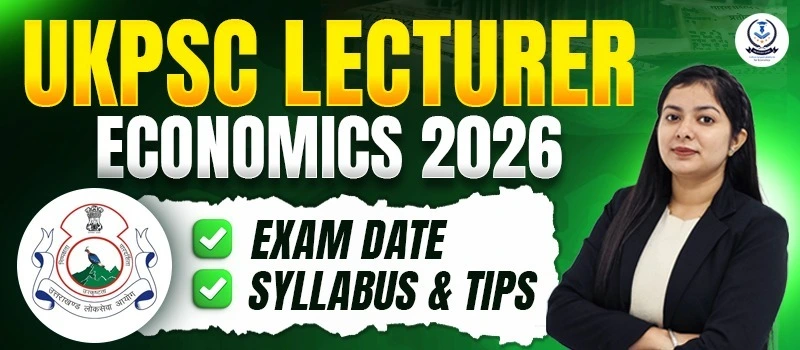
If you are preparing for UKPSC Lecturer Economics 2026, this is a very important week. The Economics exam is scheduled for 11 October 2026, and admit cards are already available. This guide explains everything in simple words: the exam date, number of posts, eligibility, syllabus, salary and a practical study plan. You do not need any background in government exams to follow it. Always confirm the final details on the official website of the Uttarakhand Public Service Commission before you act.
What Is UKPSC Lecturer Economics?
UKPSC stands for Uttarakhand Public Service Commission. It is the state body that selects teachers and officers for government jobs in Uttarakhand. The Lecturer exam is held for the Uttarakhand Special Subordinate Education (Lecturer Cadre, Group C) Service. Selected candidates teach senior classes in government inter colleges of the state.
The recruitment covers 808 posts across 16 subjects, and Economics is one of them. In simple terms, if you have studied Economics at postgraduate level and also hold a teaching degree, this exam can lead to a permanent government teaching job in Uttarakhand. The posts are divided into a General Branch and a Women Branch.
UKPSC Lecturer Economics Exam Date
The Economics exam will be held on 11 October 2026. According to a commission notice dated 23 September 2026, the Economics admit card became available from 25 September 2026. Other subjects follow later, with Sociology on 18 October and Sanskrit on 23 October 2026. The paper is objective type, which means you choose the correct answer from the options given.
How to Download the Admit Card
Visit the official UKPSC website at psc.uk.gov.in and open the Candidate Corner section. Go to the Admit Card page and find the link for the Lecturer Group C Examination 2025. Select Economics as your subject and enter the login details asked on the page. Take a clear printout and carry it to the exam centre.
As soon as you download the card, check your name, subject, date, time and exam centre address. If anything looks wrong, contact the commission immediately instead of waiting for exam day.
UKPSC Lecturer Economics Vacancies
Out of 808 total posts, Economics has 84 vacancies. Of these, 72 are in the General Branch and 12 are in the Women Branch. However, competition is high because many postgraduates apply for a limited number of government teaching posts. Steady preparation matters more than luck.
Eligibility Criteria
Qualification
As per the notification details published by education portals, a candidate needs a postgraduate degree in Economics from a recognised Indian university. A B.Ed., L.T. or an equivalent teaching qualification from a government approved institute is also required. Candidates with armed forces experience or an NCC certificate may get preference as per the rules.
Age Limit
The age limit is 21 to 42 years as on 1 July 2025. Candidates from reserved and special categories get age relaxation as per government rules. Please match every point with the official notification PDF.
Selection Process and Exam Pattern
The earlier recruitment notice mentioned two stages: a general screening test followed by a subject knowledge test. However, later updates on several education news portals say that the screening test has been removed. According to these reports, selection now depends on the subject-wise written exam, and the merit list for each subject is prepared from the marks scored in it. Because details differ between websites, the safest step is to read the latest notice on the UKPSC website and the instructions printed on your admit card.
Two points are reported consistently. First, the exam is in objective, multiple choice format. Second, there is negative marking, and one-fourth of the marks for a question are deducted for every wrong answer. This means blind guessing can reduce your score. Some sources mention two papers inside the subject exam, while others mention a single 200-mark paper. Check your admit card for the exact structure.
Economics Syllabus 2026
The Economics syllabus listed in the earlier notification has four main parts. Study them one by one and give extra time to the topics where you feel weak. The official syllabus PDF on the UKPSC website remains the final reference.
Microeconomics
Microeconomics studies the choices of individual consumers and firms. Focus on demand and supply, elasticity, consumer behaviour, production and costs, and market types such as perfect competition, monopoly and oligopoly. Draw graphs while you study, because many questions become easier when you can picture the curve.
Macroeconomics
Macroeconomics looks at the economy as a whole. Study national income, consumption and investment, money and banking, inflation, unemployment, business cycles and the role of government policy. Be clear about basic terms such as GDP, repo rate and fiscal deficit.
Indian Economy
This part is listed as developmental policies and experiences from 1947 to 1990. Revise the planning era, Five Year Plans, land reforms, the Green Revolution, industrial policy and the growth of public sector companies. Also understand the economic situation by 1990.
Statistics
Statistics can be a scoring part if your basics are strong. Practise mean, median, mode, measures of spread, correlation, regression, index numbers and simple probability.
Salary and Benefits
Lecturer posts are paid under Pay Level 8 of the 7th Pay Commission. The pay scale is Rs. 47,600 to Rs. 1,51,100 per month, along with allowances such as DA and HRA as per government rules. The job also offers stability, respect in society and a chance to shape the careers of students.
UKPSC Lecturer Economics Preparation Tips
Make a Plan
With only a few days left before 11 October, divide your time across the four syllabus parts. Do not start new books now. Revise from short notes that you have already made, and keep one hour daily for solving questions.
Practise With a Timer
Solve previous year questions and practice papers within a fixed time. After every test, write down your mistakes and revise them the same day. This habit improves both speed and accuracy.
Answer Smartly
Because of negative marking, attempt the questions you are sure about first. For doubtful questions, answer only when you can remove at least two options. This simple method protects your marks.
Stay Fresh
Sleep well, eat on time and avoid last-night cramming. A calm mind remembers more than a tired one. Spend the final evening on quick revision of formulas, definitions and graphs.
Exam Day Checklist
Keep your printed admit card and a valid photo ID ready the night before. Check the route to the exam centre and plan to reach early. Follow the rules on items allowed inside the hall, and do not carry anything that is not permitted. Read every instruction carefully, manage your time across the paper and stay calm even if the first few questions look difficult.
After the Exam
The commission publishes updates, the answer key and the result on its official website. Note down the options you marked on your question paper, so you can compare them once the answer key is out. Cut off marks depend on the difficulty of the paper and the number of candidates who appear. Check the UKPSC website regularly and stay away from fake links and rumours.
Conclusion
MS Study Guru is an online Economics exam preparation platform founded by Dr. Simranjit Kaur, who holds a PhD in Economics and qualified JRF in Economics with 99.93 percentile. MS Study Guru offers courses for Lecturer, Assistant Professor, PGT and NET level Economics exams, including a UKPSC Lecturer Economics course. If you want structured classes, notes and test practice, visit the Courses page on our website and choose the course that fits your exam.
FAQ
Q1: When is the UKPSC Lecturer Economics exam 2026?
Ans. The UKPSC Lecturer Economics exam is scheduled for 11 October 2026. According to the commission notice dated 23 September 2026, the Economics admit card has been available since 25 September 2026 on the official UKPSC website.
Q2: How many vacancies are there for Economics in UKPSC Lecturer 2026?
Ans. Economics has 84 vacancies out of 808 total Lecturer posts. Of these, 72 posts are in the General Branch and 12 posts are in the Women Branch.
Q3: What is the eligibility for UKPSC Lecturer Economics?
Ans. A candidate needs a postgraduate degree in Economics and a B.Ed., L.T. or equivalent teaching qualification. The age limit is 21 to 42 years as on 1 July 2025, with relaxation for reserved categories as per rules.
Q4: Is there negative marking in the UKPSC Lecturer Economics exam?
Ans. Yes. Education portals report that one-fourth of the marks of a question are deducted for each wrong answer. Always confirm the marking scheme in the official notice and the instructions on your admit card.
Q5: What is the syllabus for UKPSC Lecturer Economics 2026?
Ans. The Economics syllabus has four parts: Microeconomics, Macroeconomics, Indian Economy (developmental policies and experiences from 1947 to 1990) and Statistics. Check the official syllabus PDF on psc.uk.gov.in for final details.


Comments (0)