Education
UPPSC GIC Lecturer Economics Syllabus 2026 & Exam Pattern
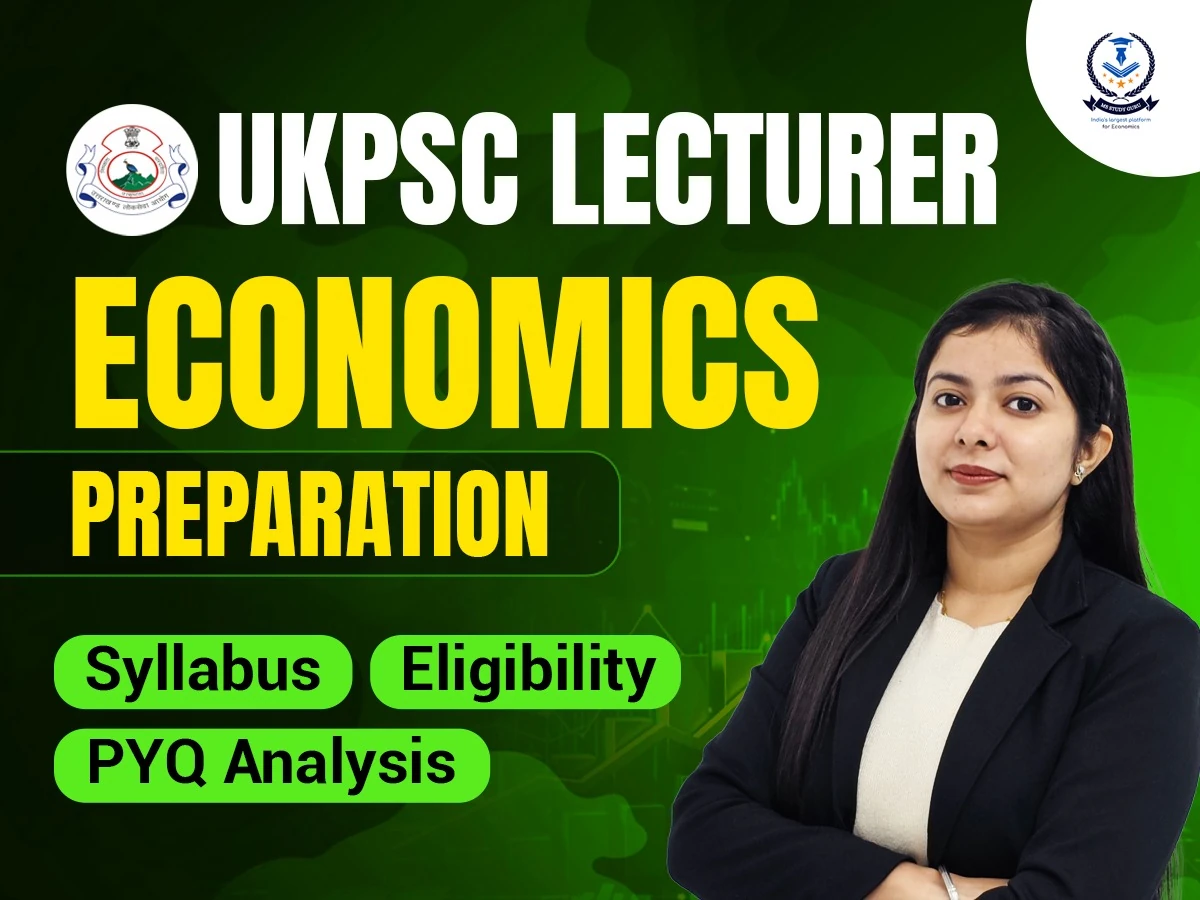
The year 2026 marks a highly competitive era for traditional government teaching exams, and the UPPSC GIC (Government Inter College) Lecturer position remains one of the most prestigious roles in Uttar Pradesh's educational framework. Teaching Economics at this level demands more than just rote memorization; it requires a deep, intuitive understanding of structural frameworks, micro-macro dynamics, and mathematical applications.To help you clear this highly competitive exam, MS Study Guru brings you an unparalleled, comprehensive preparation roadmap. Led by India’s leading Economics Expert, Dr. Simranjit Kaur.The MS Study Guru Philosophy
At MS Study Guru, we believe that success in highly competitive examinations like UPPSC GIC comes from strong conceptual understanding and smart answer presentation. Our focus is on delivering deeply engaging, high-yield *video lectures* that build conceptual clarity, strengthen numerical problem-solving skills, and develop analytical thinking. Along with this, we provide well-structured *model answers* for subjective and descriptive exams so that students learn how to frame answers effectively and score maximum marks.
3. Role Definition
The UPPSC GIC Lecturer (Economics) is a Group 'B' Gazetted officer position within the Department of Secondary Education, Uttar Pradesh. Candidates selected through this exam are posted in Government Inter Colleges across the state.Unlike general administrative roles, this position is purely academic and analytical. As an Economics Lecturer, you are responsible for building the foundational economic understanding of senior secondary students, preparing them for advanced academic pursuits. The role commands massive respect in society, offers excellent work-life balance, and provides a clear career progression path toward Principal positions and administrative roles within the state education department.4. Comparison Table: GIC Lecturer vs. PGT Economics
To understand the unique prestige and structural depth of the UPPSC GIC Lecturer role, it is essential to compare it with the regular PGT (Post Graduate Teacher) cadre in aided/private institutions. | Feature | UPPSC GIC Lecturer (Economics) | Regular PGT Economics (Aided/Private) |
| Cadre Status | Group ‘B’ Gazetted Officer | Non-Gazetted Teaching Staff |
| Selection Process | Highly rigorous Two-Tier Written Exam (Prelims + Mains) | Single-tier exam or direct interview-based systems |
| Exam Nature | Demands rigorous descriptive answer writing in Mains | Primarily objective/multiple-choice driven |
| Focus Area | Deep conceptual analysis, economic policy, and data interpretation | Textbook syllabus delivery and conventional theory |
| Work Environment | Government Inter Colleges (Direct State Govt. Employee) | Government-aided or private institution management |
5. Eligibility Criteria
Aspirants must satisfy the following criteria to be eligible for the UPPSC GIC Lecturer Economics recruitment in 2026:Age Limit & Relaxations
- Minimum Age: 21 years
- Maximum Age: 40 years
- Age Relaxations: Relaxations apply for reserved categories (SC/ST/OBC) as per Uttar Pradesh state government rules.
- Higher Degree Extensions: Special considerations and age relaxations up to 5 years are applicable for candidates holding advanced research degrees like an M.Phil or Ph.D. in Economics, or those with prior verified teaching experience in state-recognized institutions.
Educational Qualifications
Candidates must fulfill at least one of the following primary academic qualification paths: - Option A: Master’s Degree (Post Graduation) in Economics from a University established by law in India, or a qualification recognized by the Government as equivalent thereto.
- Option B: Specialized Master's degree variants (e.g., Applied Economics / Business Economics), provided they hold a government equivalence certification for the GIC Lecturer cadre.
- Minimum Marks Requirement: A minimum of 55% marks (or equivalent grade) in the Post-Graduation degree for General/OBC candidates, and 50% marks for SC/ST candidates.
Desirable Qualifications
While not strictly mandatory, preference is given to candidates who possess: - A Bachelor of Education (B.Ed.) degree from a recognized university.
- Two years of active service in the Territorial Army.
- A National Cadet Corps (NCC) 'B' Certificate.
6. Exam Pattern Tables
The UPPSC GIC Lecturer selection process completely bypasses the traditional interview round, making the written examination the sole criterion for selection. The exam is split into two distinct phases.Phase I: Preliminary Examination (Objective Type)
The Preliminary round serves as a screening test. The marks scored here are not counted toward the final merit list. | Paper Component | Number of Questions | Total Marks | Duration | Negative Marking |
| General Studies | 40 Questions | 120 Marks | 2 Hours (Combined) | 1/3rd ($0.33$) for every wrong answer |
| Optional Subject (Economics) | 80 Questions | 180 Marks | 2 Hours (Combined) | 1/3rd ($0.33$) for every wrong answer |
| Total | 120 Questions | 300 Marks | 2 Hours | — |
Phase II: Mains Examination (Descriptive/Subjective Type)
The final merit list is prepared entirely based on the marks secured in this phase. | Exam Part | Subject / Section | Total Marks | Duration | Paper Nature |
| First Paper | General Hindi & Essay Writing | 100 Marks | 2 Hours | Descriptive Written |
| Second Paper | Optional Subject (Economics) | 300 Marks | 3 Hours | Descriptive Written |
| Grand Total | All Sections | 400 Marks | 5 Hours Total | Final Merit Basis |
Important Note on Mains Question Distribution: The Mains Economics paper contains 20 mandatory descriptive questions divided into Section A (5 Long Answer questions, 25 marks each), Section B (5 Medium Answer questions, 15 marks each), and Section C (10 Short Answer questions, 10 marks each).7. Syllabus Overview
The UPPSC GIC Lecturer Economics syllabus requires a balance of core theory and Indian economic realities.Phase I (Preliminary) Core Syllabus
- Microeconomic Analysis: Consumer behavior, demand theory, production function, market structures (Perfect Competition, Monopoly, Oligopoly), and distribution theories.
- Macroeconomic Analysis: National Income accounting, classical vs. Keynesian models, consumption and investment functions, inflation, and monetary-fiscal policies.
- Money, Banking, and Public Finance: Central and commercial banking, public expenditure, taxation systems, public debt, and fiscal federalism in India.
- International Economics: Theories of absolute and comparative advantage, terms of trade, balance of payments (BoP) adjustments, tariffs, and global bodies (WTO, IMF, World Bank).
- Growth and Development models: Harrod-Domar, Solow, Lewis, and balanced vs. unbalanced growth models.
Phase II (Mains) Advanced Modules
- Advanced Econometrics & Statistical Tools: Linear regression models, hypothesis testing, index numbers, and time-series interpretation.
- The Indian Economy (Structure & Trends): Indian agriculture, industrial growth patterns, poverty, unemployment, population dynamics, and NITI Aayog strategies.
- Uttar Pradesh State Economy: Specific resource distribution, agricultural patterns, industrial corridors, and budgetary allocations within UP.
- Descriptive Answer Architecture: Developing the skill to write precise, multi-dimensional economic arguments, draw clear diagrams, and provide mathematical proofs under strict time constraints.
8. Recommended Reference Matrix
To build your knowledge base, focus on standard reference materials. Use these books alongside MS Study Guru’s concept-driven video lectures for the best results. | Core Subject Area | Recommended Textbook / Resource | Primary Author / Publisher | Focus Area & Strategy |
| Microeconomics | Advanced Economic Theory | H.L. Ahuja | Market structures, optimization, and consumer equilibrium proofs. |
| Macroeconomics | Macroeconomic Theory & Policy | H.L. Ahuja / Froyen | Keynesian models, IS-LM curves, and monetary policy mechanisms. |
| International Economics | International Economics | Dominick Salvatore | Trade models, tariff impact charts, and BoP structures. |
| Public Finance | Public Finance in Theory & Practice | Musgrave & Musgrave / Lekhi | Taxation principles, fiscal policy, and public goods. |
| Development Economics | Growth & Development | Thirlwall / M.L. Jhingan | Economic growth models and structural development indices. |
| Indian Economy | Indian Economy since Independence | Uma Kapila / Ramesh Singh | Structural transformations, agricultural reforms, and data updates. |
| Official Reports | Union Budget & Economic Survey 2026 | Government of India | Current data, fiscal deficits, and active welfare schemes. |
9. Salary & Benefits (2026 Matrix)
The UPPSC GIC Lecturer position offers excellent compensation alongside job security. The salary structure in 2026 follows the 7th Pay Commission guidelines: - Pay Matrix Level: Level 8
- Pay Band: $Rs. 47,600 - Rs. 1,51,100$
- Initial Core Basic Pay: $Rs. 47,600$
- Estimated Gross Monthly Emoluments (2026): Approx. $Rs. 72,000 - Rs. 82,000$ per month (This varies slightly based on city classification and includes updated Dearness Allowance (DA), House Rent Allowance (HRA), and Medical Allowances).
- Additional Perks: Secure government accommodation options, defined contributory pension benefits, comprehensive medical insurance protection for family members, and regular academic leaves.
10. Exam Highlights Table
| Detail | Information |
| Conducting Body | Uttar Pradesh Public Service Commission (UPPSC) |
| Exam Level | State Level (Uttar Pradesh) |
| Frequency of Exam | Periodic / Vacancy-Based |
| Mode of Examination | Offline (Pen and Paper-based Written Exam) |
| Language of Exam Paper | Bilingual (Hindi and English) |
| Application Fee | General/OBC: $Rs. 125$ | SC/ST: $$Rs. 6$ | PH: $ $Rs. $ |
| Official Website | uppsc.up.nic.in |
11. Smart Preparation Strategy
1. Shift from Rote Memorization to Conceptual Clarity
The UPPSC GIC Mains exam features descriptive questions that test your deeper understanding of economic concepts. You cannot crack this exam by simply memorizing definitions. Focus on understanding the "why" behind economic shifts, policy adjustments, and structural theories.2. Learn Advanced Econometrics via Video Explanations
Mathematical economics and basic econometrics are often tough for students to self-study through textbooks. Instead of relying on static notes, use step-by-step video lectures to break down formulas, hypothesis testing, and statistical proofs into manageable parts.3. Practice Core Macro Diagrams
Every descriptive answer in Mains should feature clean, accurate economic diagrams. Practice drawing IS-LM frameworks, indifference curve adjustments, and market equilibrium shifts under timed conditions. A well-drawn diagram instantly boosts your score.4. Integrate Current Economic Data
Do not rely on outdated statistics. Make sure your answers feature the latest data from the Economic Survey 2026, the Union Budget, and specific state economic indices for Uttar Pradesh. Linking economic theories to current real-world events shows examiners that you truly understand the subject.5. Structure Your Mains Answers for Maximum Impact
Train yourself to write structured answers. Every long response should follow a logical flow: - A clear, concise Introduction defining the core economic concept.
- A comprehensive Body featuring mathematical steps, theoretical proofs, and diagrams.
- A balanced Conclusion that highlights policy implications or future outlooks.
12. Conclusion & Brand Closing
Clearing the UPPSC GIC Lecturer Economics exam requires a smart mix of core conceptual clarity, analytical thinking, and structured answer writing. Since the selection process relies entirely on the written exam, guessing or relying on surface-level notes will not get you results.At MS Study Guru, we change the way you prepare. We do not just hand you static, text-heavy notes. Instead, we give you high-quality, concept-driven video lectures designed to make complex economics accessible. Our Courses

Comments (0)