
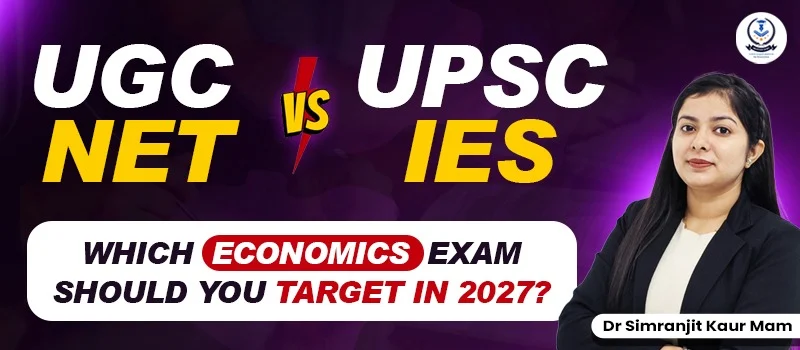
If you are an economics graduate aspiring for a prestigious career in the Government of India, the Indian Economic Service (IES) is the ultimate goal. Conducted annually by the Union Public Service Commission (UPSC), the IES exam is a specialist-level gateway to becoming a top-tier economic advisor, policy-maker, and analyst for the nation.
Planning to crack the IES 2026 exam? This complete guide will provide you with every crucial detail—from tentative exam dates and detailed eligibility criteria to the syllabus breakdown, salary structure, and the right preparation strategy to secure your selection.
1. What is the Indian Economic Service (IES)?
The Indian Economic Service is an organized Group ‘A’ central civil service. Officers selected through this exam are placed in the economic advisory framework of the government. They play a critical role in drafting the Union Budget, designing economic policies, analyzing foreign trade, and evaluating the impact of government schemes.
As an IES officer, you can be posted in prominent ministries like the Ministry of Finance, NITI Aayog, Ministry of Commerce and Industry, and the Ministry of Statistics and Programme Implementation (MoSPI).
2. UPSC IES 2026: Tentative Exam Dates
While the official UPSC calendar for 2026 is yet to be released, based on previous years' trends, the IES exam cycle usually follows this timeline:
- Release of Official Notification: April 2026
- Start of Online Application: April 2026
- Last Date to Apply: May 2026
- Admit Card Release: June 2026
- UPSC IES 2026 Exam Date (Written): June 2026 (Usually a 3-day exam)
- Result Declaration (Written): August 2026
3. IES 2026 Eligibility Criteria
Before beginning your preparation, you must ensure that you meet the strict eligibility parameters set by the UPSC for the Indian Economic Service.
A. Educational Qualification
- You must hold a Post-Graduate Degree (Master’s Degree) in Economics / Applied Economics / Business Economics / Econometrics from a recognized university incorporated by an Act of the Central or State Legislature in India.
- Note: Candidates who are appearing in their final year of the Post-Graduate degree are also eligible to apply, provided they can produce proof of passing at the detailed application form (DAF) stage.
B. Age Limit
- Minimum Age: 21 Years
- Maximum Age: 30 Years
- Age Relaxations:
- OBC Candidates: Up to 3 years.
- SC/ST Candidates: Up to 5 years.
- Persons with Benchmark Disabilities (PwBD): Up to 10 years.
- Ex-Servicemen: Up to 5 years.
C. Nationality
- A candidate must be either a citizen of India, a subject of Nepal/Bhutan, or a Tibetan refugee who came to India before January 1, 1962, with the intention of permanently settling in India.
4. UPSC IES Exam Pattern 2026
The IES exam relies entirely on your descriptive writing skills and deep conceptual understanding. There are no objective-type (MCQ) questions in the core subject papers. The selection process is divided into two parts:
Part I: Written Examination (1000 Marks)
The written exam spans three days and consists of six descriptive papers.
|
|
|
|
|
|
|
|
|
|
|
|
|
|
|
|
|
|
|
|
|
|
|
|
|
|
|
|
|
|
|
|
|
|
|
Part II: Viva-Voce / Interview (200 Marks)
Candidates who clear the written exam cutoff are called for a personality test. The interview panel assesses your practical knowledge, awareness of national/international economic issues, and your suitability for the role of an economic administrator.
5. Syllabus Overview for IES
- General English: Essay writing, precis writing, vocabulary, and grammar.
- General Studies: Indian history, geography, polity, current affairs, and general science.
- General Economics I: Microeconomics, Mathematical Methods in Economics, Statistics, and Econometrics.
- General Economics II: Macroeconomics, Monetary Economics, International Economics, and Growth & Development Theories.
- General Economics III: Public Finance, Environmental Economics, Industrial Economics, and State/Market Planning.
- Indian Economics: History of Indian economy, agriculture, industry, poverty, unemployment, fiscal policy, Union Budget, and the Economic Survey.
6. The MS Study Guru Advantage: Video Lectures & Exam-Relevant Notes
Cracking the IES exam requires more than just reading textbooks. The descriptive nature of the exam means you have to derive complex equations, draw precise graphs, and present your arguments logically.
Many students fail because they rely on shortcuts and passive rote learning from random PDFs. However, the IES exam demands a highly analytical approach.
At MS Study Guru, our primary focus is on building absolute concept clarity. We provide comprehensive video lectures perfectly paired with highly relevant, exam-oriented class notes.
When you prepare with our expert video lectures, led by Dr. Simranjit Kaur, you deeply understand the 'why' and 'how' behind every economic theory. We believe that true understanding eliminates the need for memorization. Once your fundamental concepts are crystal clear through our video guidance and structured notes, you will easily be able to construct your own high-scoring, descriptive answers in the exam hall.
7. Salary and Perks of an IES Officer
Joining the Indian Economic Service offers a highly lucrative, secure, and respected career profile.
- Pay Scale: An entry-level IES Officer (Assistant Director / Research Officer) starts at Pay Level 10 of the 7th Pay Commission.
- Basic Pay: ₹56,100 per month.
- Gross Salary: Including Dearness Allowance (DA), House Rent Allowance (HRA), and Transport Allowance (TA), the initial in-hand salary ranges between ₹90,000 to ₹1,00,000 per month, depending on the posting city.
- Perks: Government accommodation, medical facilities, pension benefits, official vehicle access (depending on rank), and opportunities for foreign deputations.
8. How to Prepare for IES 2026?
- Clear the Basics First: Start with Micro and Macroeconomics. Watch our concept-driven video lectures to build a solid foundation before moving to complex mathematical economics.
- Focus on Econometrics: Do not ignore Statistics and Econometrics. Practice numericals regularly, as they form a high-scoring section in General Economics I.
- Read the Economic Survey: The Indian Economics paper heavily relies on current data. Study the latest Union Budget and Economic Survey of India thoroughly.
- Practice Answer Writing: Since all 6 papers are descriptive, your writing speed and presentation matter. Practice writing 2-3 answers daily. Use proper headings, bullet points, and perfectly labeled diagrams.
Conclusion
The Indian Economic Service 2026 is a golden opportunity for dedicated economics graduates. Start your preparation early, stick to the syllabus, and prioritize concept clarity over rote learning. With the right mentorship, structured video lectures, and consistent writing practice at MS Study Guru, achieving the IES dream is well within your reach!
Q1. What is the age limit for the IES 2026 exam?
Ans. The candidate must be between 21 and 30 years of age as of 1st August of the exam year. Standard age relaxations apply for OBC (3 years), SC/ST (5 years), and PwBD candidates (10 years).
Q2. Can final-year post-graduation students apply for IES 2026?
Ans. Yes, candidates appearing in their final year of the Master's degree in Economics/Applied Economics/Econometrics can apply, provided they submit the proof of passing during the Detailed Application Form (DAF) stage.
Q3. Are there any objective (MCQ) questions in the IES exam?
Ans. No, the written examination for the Indian Economic Service consists entirely of 6 subjective (descriptive) papers. You must write detailed analytical answers for all subjects.
Q4. How does MS Study Guru help in IES preparation?
Ans. MS Study Guru focuses on deep concept clarity rather than rote learning. We provide comprehensive video lectures by Dr. Simranjit Kaur, paired with exam-relevant class notes, to help you master economic models and write highly effective descriptive answers.

Comments (0)